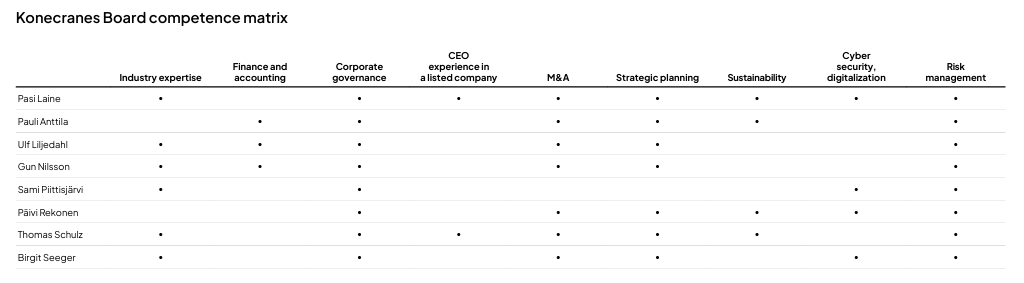
The Board has a diversity policy. According to the policy, the Members of the Board of Directors are always selected based upon their expected contribution and effectiveness as members of the Board of Directors, and capability to positively influence the long-term strategic direction and performance of the Company. As a team, the Board of Directors works for the benefit of the key stakeholders, including customers, employees and shareholders. Diversity in the composition of the Board of Directors enables high-quality decision-making.
When considering diversity within the Board of Directors, the main attribute is diversity of thought, including individual professional and educational experiences, influenced by various diversity factors. Board selections are based on a candidate’s background and competency to understand Konecranes’ industry, current and future markets, strategy, employees, and customers, including a sound understanding of financials and business dynamics. Collectively, the Board of Directors should have combined experience in different markets, geographies and important topics, such as digitalization, sustainability (ESG), corporate governance, M&A, accounting and finance, and cybersecurity.
For a well-functioning Board of Directors, it is important that the Board members are committed to the Board work and have the possibility to devote the time needed to understand the Company’s current situation, customers and strategy.
The most important nomination criteria for Board candidates are competence, knowledge, personal qualities and integrity. Konecranes’ aim is to strive towards a good and balanced Board composition taking into account all aspects of Board diversity. The target is to have a balanced representation of both genders in the Board. A balanced representation is realized when the proportion of the underrepresented gender is at least 40 percent or a number indicated in accordance with the rounding rules of the Limited Liability Companies Act.
At the end of 2025, three out of eight Board members were female, representing 38% of the total. The Board consisted of people representing three different nationalities and with experience from four different decades of birth. The Board had versatile work experience and different educational backgrounds from the fields of engineering and economics.